New product launch comming soon...

Class AB vs. Class D: The Shootout (Cambridge Audio Azur vs. Fosi Audio V3 Mono)
A direct shootout between the classic 'British Sound' of the Cambridge Audio Azur (Class AB) and the modern precision of the Fosi V3 Monos (Class D). Testing with the Allo Boss 2 and JBL floor standers, this review explores whether modern PFFB technology can finally replace the warmth and soul of vintage heavy iron.
SK AUDIO REVIEWS
Siby Koshy
2/7/20268 min read

In the world of audiophiles, there is a long-standing dogma: Class AB has "soul," and Class D is "sterile."
For decades, if you wanted serious high-fidelity sound, you bought a heavy, heat-generating Class AB amplifier with a massive toroidal transformer inside. Class D was dismissed as "digital" (even though it isn't), harsh, and fit only for subwoofers or cheap Bluetooth speakers.
To understand it better, here is a breakdown of the dogma, the technology, and the modern reality:
The Heavyweight Champion: Class AB
The "soul" attributed to Class AB comes from its linearity and history. It is the architecture that powered the golden age of rock and jazz.
How it works: Class AB is a compromise between Class A (pure, inefficient, always fully "on") and Class B (efficient, but prone to distortion). In a Class AB amp, the transistors are slightly biased so they are always conducting a little bit of current. This eliminates the "crossover distortion" that happens when the audio signal swings from positive to negative.
The "Soul": Because Class AB amps operate linearly, they tend to have a very low noise floor and excellent high-frequency extension without complex filtering. The "warmth" often cited is sometimes a result of slight, even-order harmonic distortion, which human ears find pleasing.
The Cost: They are incredibly inefficient (often around 50–60%). The rest of that energy turns into heat, requiring those massive heatsinks and heavy toroidal transformers mentioned in your text.
The Modern Take: Class D
The "sterile" reputation of Class D stems from its earliest iterations in the 1980s and 90s, which were indeed flawed.
How it works: Class D is not digital (a common misconception). It is an "analog switching" technology. Instead of amplifying the wave linearly, it turns the output transistors fully "on" or fully "off" at a very high frequency (hundreds of thousands of times per second). This creates a square wave that represents the audio signal through Pulse Width Modulation (PWM).
The "Digital" Myth: It is called "Class D" simply because it was the next letter after Class C. Because it uses "on/off" states, people conflate it with binary digital data, but the timing of the pulses is analog.
The "Sterile" Stereotype: Early Class D amps suffered from three main issues:
Load Dependence: The frequency response would change depending on the speaker's impedance curve (a nightmare for complex speakers).
High-Frequency Noise: The switching process created noise that had to be aggressively filtered out, often "smearing" the treble or making it sound harsh and grainy.
To test if the old stereotypes still hold water, I decided to pit two very different amplifiers against each other in a direct shootout driving my JBL Studio Series floor standers.
The Contenders:
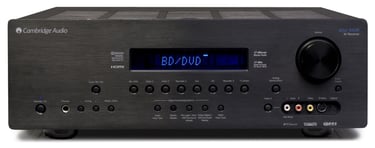
The Old Guard: Cambridge Audio Azur
"The Heavy Metal"
When I describe the Azur as having the "British Sound," I am invoking a very specific audio heritage.
The "British Sound": This generally refers to an emphasis on a warm, rich midrange and a "polite" top end. It prioritizes musicality and "prat" (Pace, Rhythm, and Timing) over surgical, clinical detail. It is the sound of vocals and acoustic instruments feeling present and natural.
The Weight: That heaviness I mentioned comes primarily from the Toroidal Transformer. In a Class AB amp like the Azur, this massive ring of iron and copper is the heart of the system. It provides the current needed to drive bass transients. Its physical weight is often a proxy for its ability to deliver stable power.
The Heat: The warmth isn't just sonic; it's thermal. As discussed, the output transistors are shedding energy as heat to stay in their linear operating region. This inefficiency is the price paid for that smooth, "organic" texture.
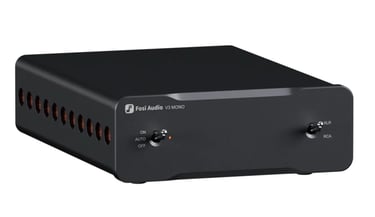
The New Wave: Fosi Audio V3 Monos
"The Smart Bricks"
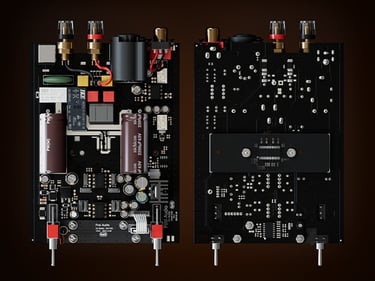
The Fosi V3 Monos represent a democratization of high-end features that were previously impossible at this size and price point.
Monoblock Architecture: Historically, running separate amplifiers for the Left and Right channels (Monoblocks) was a luxury reserved for the wealthy. It completely eliminates "crosstalk" (where the signal from one channel bleeds into the other), resulting in a wider, more precise stereo image. The fact that these "mini bricks" offer this configuration is a major disruptor.
The Secret Weapon: PFFB (Post-Filter Feedback): This is the critical tech that makes this a fair fight.
The Problem: Older Class D amps had a flaw where their frequency response would change depending on the speaker's impedance. A speaker that dipped in impedance might sound bright or dull depending on the amp.
The PFFB Solution: This technology takes a feedback signal from after the output filter (right at the speaker terminals) and sends it back to the control loop. It effectively tells the amp, "This is what the speaker is doing, correct yourself." It ensures a flat frequency response regardless of the load, removing the "unpredictability" of early Class D.
The Setup
To keep this shootout honest, I needed a control variable—a neutral arbiter that wouldn’t favor one amp over the other. For the source, I stuck with the Allo Boss 2 Streamer.
In the world of streamers, the Boss 2 is something of a "giant killer." It’s known for being incredibly transparent with low jitter, meaning any "warmth" or "sterility" I heard would come strictly from the amplifiers, not the source. To keep the playing field level, I resisted the urge to use the Fosi’s balanced XLR inputs. Since my vintage Cambridge only speaks RCA, I ran both amps via the single-ended RCA outputs. This ensured that the Fosi didn’t win simply on a technicality of connection type.
For the music, I avoided the trap of playing "audiophile test tones" that I don't actually enjoy. Instead, I curated a "Familiarity Benchmark"—tracks I know so intimately that I can spot a change in texture instantly.
90s Hindi Music (The Midrange Test): I started here because this era—think A.R. Rahman or Nadeem-Shravan—is defined by lush orchestration and very forward vocals. This is the home turf of the Class AB "British Sound." My goal was to see if the Class D Fosi could render the emotional weight of Udit Narayan or Alka Yagnik without making them sound thin or metallic.
Malayalam Songs (The Texture Test): I queued these up to test transient response. With their intricate percussion work (mridangam and chenda), I wanted to see if the amps could stop and start on a dime. I was looking for the "snap" of the drum skin—would it be sharp (Class D strength) or slightly rounded (Class AB warmth)?
English Tracks (The Nostalgia Trip): Finally, I moved to the music I actually grew up with during the golden era of 80s and 90s pop and rock. I queued up the lush ballads of Michael Learns To Rock, Boyzone, and Westlife to see if the amps could separate those layered vocal harmonies without losing their emotional warmth. I threw in Bryan Adams to test if his signature raspy vocals retained their grit, and finished with the ultimate production test: Michael Jackson. This was the gauntlet for dynamics and timing, needed to hear if the amps could keep up with the razor-sharp precision of MJ’s rhythm section while still delivering the iconic "punch" I remember from my childhood.
The Listening Impression
Bass Control: Lingering vs Tight
Cambridge Audio Azur: The Cambridge delivers what I call "Lingering Bass”. The bottom end feels weighty and substantial, filling the room with a sense of physical scale. On slower, acoustic tracks or sweeping orchestral numbers, this is magnificent; it gives the music a strong foundation. However, on faster electronic tracks or the razor-sharp rhythm sections of Michael Jackson, that weight comes at a cost. The bass can feel slightly "slow" or boomy. This is likely due to a lower damping factor, meaning the amp isn't stopping the speaker cone quite as instantly after the note is hit, resulting in a slight overhang that blurs the edges of the beat.
Fosi V3 Monos: The moment I switched to the Fosis, the difference was physics in action. The bass didn't just get quieter; it got faster. The boominess vanished, replaced by a tight, visceral impact. This is the "Class D Tightness" These amps exert immense control over the woofers, starting and stopping the cone with absolute precision. When the kick drum hits on a modern pop track, it hits you in the chest and immediately retracts, leaving space for the next note. It trades the "enveloping warmth" of the Cambridge for pure, articulated impact.
The Midrange: The "Soul" vs. The Truth
Cambridge Audio Azur: This is the stronghold of the Old Guard. The Cambridge possesses a distinct "sweetness/warmth" a characteristic likely resulting from even-order harmonic distortion, which the human ear interprets as warmth. Male vocals, like Bryan Adams or the baritones in 90s Boyzone ballads, sound rich, textured, and slightly larger than life. Acoustic guitars resonate with a golden, woody timbre. It’s an "interpretive" presentation; the amp is adding a layer of gloss that makes everything sound effortless and organic. It’s the audio equivalent of a warm filter on a photograph.
Fosi V3 Monos: The Fosi, by contrast, is a "What you give is what you get" It is uncolored and surgically clean. Thanks to the PFFB (Post-Filter Feedback) technology, it avoids the hollow, recessed mids that plagued early Class D amps, keeping the vocals forward and present. However, it offers no place to hide. If a recording is dry or thin, the Fosi will tell you exactly that. It lacks the "euphonic distortion" of Cambridge. It presents the vocals exactly as they were recorded, not as we might wish they sounded. It forces you to ask: Do I want the truth (Fosi), or do I want to be charmed (Cambridge)?
High Frequencies & Detail: The Sound of Silence
Cambridge Audio Azur: The Cambridge exhibits the classic "British Sound" roll-off. The treble is smooth, polite, and gently tapered. This is a forgiving tuning; it tames the harshness of bright recordings and sibilant vocals. I could listen to this amp for five hours straight without a hint of listener fatigue. It sacrifices the last 5% of "sparkle" for 100% listenability.
Fosi V3 Monos: The Fosi lifts the veil. The frequency extension goes further, revealing the "air" and spatial cues around cymbals and high-hats that the Cambridge glosses over. But the most dramatic difference is the Noise Floor. Because the Fosi V3s are monoblocks (physically separate amplifiers for left and right), crosstalk is eliminated, and the background is "absolute emptyness”. The silence between the notes is absolute. By contrast, the vintage Cambridge, with its massive transformer, carries a faint mechanical hum and higher noise floor. With the Fosi, the dynamic range feels wider simply because the music emerges from total nothingness.
Conclusion: The Science of Sound vs. The Art of Listening
After days of critical listening, I am forced to admit that the "dogma" is technically dead. The Fosi V3 Monos proved that Class D is no longer "digital" or "sterile." In purely objective terms speed, resolution, noise floor, and grip the little bricks beat the heavy metal. They told the truth about every recording I threw at them.
But here is the catch: I don't think I want the truth.
Despite the Fosi’s technical superiority, I found myself consistently gravitating back to the Cambridge Audio Azur. To my ears, that "dated" Class AB warmth simply sounds better.
I suspect this is a matter of psychoacoustic conditioning. I grew up in an era defined by the sound of Class AB amplifiers. My brain has spent decades learning that "good sound" equals a slightly thickened midrange, a rolled-off treble, and a heavy, lingering bass. To me, that coloration isn't distortion; it's music. The Fosi might be "right," but because it lacks that familiar sonic signature, my brain perceives it as "clinical."
Conversely, a listener from a newer generation, someone raised on pristine digital files and high-resolution personal audio might listen to my beloved Cambridge and find it muddy or colored. They might find the Fosi’s razor-sharp accuracy to be the only true standard of high fidelity.
To check if I was just being nostalgic, I brought in the ultimate blind test subject: my wife. She has no interest in amplifier classes or damping factors; she just listens to the music. Her verdict was immediate and consistent. She preferred Cambridge Audio. Even now, for our long, relaxing sessions of low-volume listening in the evenings, the Fosi stays off. We still power up the heavy, heat-generating Cambridge.
The Fosi V3 Monos are incredible feats of engineering that deserve every bit of their hype. They have proven that you can buy high-end performance for a budget price. But for me, the "soul" of the music seems to live in the imperfections of the Old Guard. The Fosi stimulates my brain, but Cambridge still wins my heart.
Contact: sibykdxb@gmail.com
Copyright © All rights reserved.