New product launch comming soon...

Truthear Zero Red vs. 7Hz Salnotes Zero 2
Truthear Zero Red ($55) vs. 7Hz Salnotes Zero 2 ($25): A definitive head-to-head review. I test sound quality, driver technology, and comfort to answer the ultimate question: Does spending double the money actually get you double the sound?
1/26/20269 min read
We are living in the absolute golden age of "Chi-Fi" (Chinese Hi-Fi). It is a time when the barrier to entry for high-fidelity audio has crumbled, allowing anyone to experience incredible sound for the price of a decent lunch. But this accessibility comes with a catch: the market is flooded. With a new "giant killer" released every other week, price rarely equals performance, and the paradox of choice has never been more paralyzing.
To help cut through the noise, I am pitting two of the absolute heavyweights in my collection against one another. These aren't just review units I’ve touched for a week; they are staples in my rotation.
In the Red corner, we have the Truthear x Crinacle Zero Red (approx. $55). This is the dual-driver darling, a collaboration that promises "reference" grade tonality and distinct woofer-tweeter separation. It positions itself as the grown-up choice for the discerning listener.
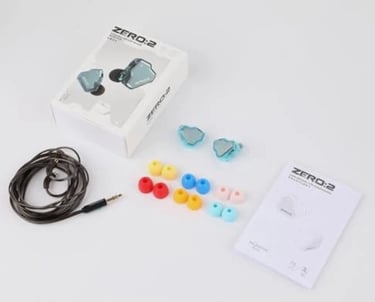
In the opposing corner, we have the 7Hz Salnotes Zero 2 (approx. $25). As the sequel to a legend, it has big shoes to fill, claiming to offer the perfect balance of fun and fidelity for less than half the cost of its competitor.
The Setup & Methodology
I have owned both sets for over a year, but to truly understand the nuance between them, I conducted a specific experiment. For the last month, I exclusively used only these two IEMs, driving them both with my iBasso DC04 Pro dongle DAC to ensure they were fed a clean, powerful source.
This comparison seeks to answer the ultimate question in budget audio: Does spending more than double the money actually get you double the sound? Or is the cheaper Zero 2 the smarter buy for the average listener? The answer is complicated, so let’s dive in.
Build & Comfort: The Physical Battle
Before we talk about sound, we have to talk about the physical reality of putting these things in your ears. This is where the price difference and the design philosophy becomes immediately apparent.
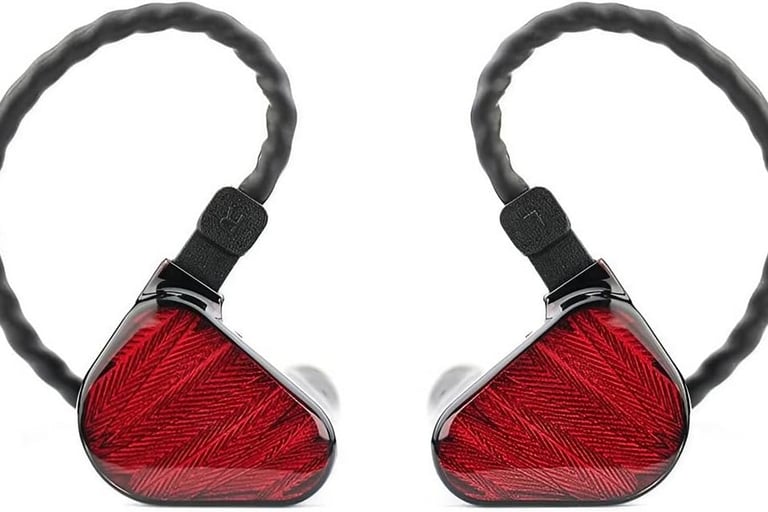
Truthear x Crinacle Zero Red
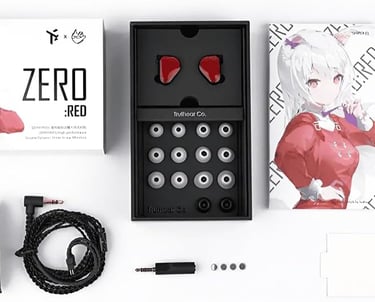
Visually and tactually, the Zero Red punches above its weight. The smooth, 3D-printed resin shell feels dense and substantial in the hand, mimicking IEMs that cost three or four times as much. It has a stroking design and looks professional. However, this premium build hides a significant Achilles' heel: the nozzle size.
To accommodate the complex dual-dynamic driver setup (a dedicated woofer and tweeter stacked inside), Truthear had to make the nozzle exceptionally thick (approx. 6mm+).
The Fit Test: For me, they fit securely and isolate noise incredibly well. However, I put them to the "spouse test," and it was a no-go. My wife, who has smaller ear canals, it was not a comfortable fit.
The Verdict: If you have medium-to-large ear canals, you will likely find them stable and secure. If you have small ears, this IEM is a risky gamble. It is a large unit that demands space.
7Hz Salnotes Zero 2
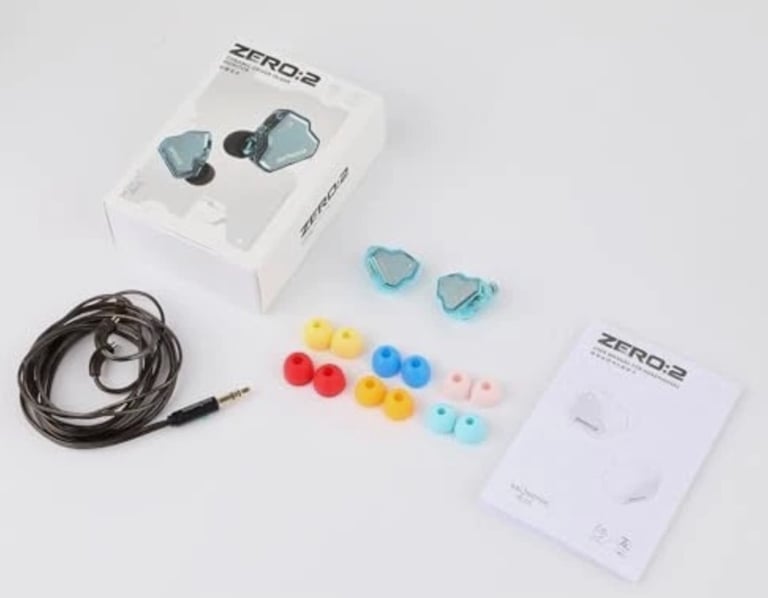
Picking up the Zero 2 immediately after the Red is a jarring experience. Despite the claims of a durable chassis, the lightweight, angular medical grade resin construction feels distinctly budget-oriented. I own the Blue colour, and frankly, it looks and feels a bit toy-like compared to the dense resin of the Red. It doesn't scream "Luxury” it screams "Purpose Built".
However, this lack of heft is its secret weapon.
The Fit Test: Because they are so light and utilize a standard-width nozzle, the ergonomics are vastly superior for the average user. The angular shape, which looks sharp, actually sits quite comfortably in the ear.
The Verdict: I found I could wear the Zero 2 for an entire afternoon of listening without ever feeling "ear fatigue." They essentially disappear once inserted, something the bulky Reds never quite achieve.
The Tech: Dual-Driver Complexity vs. Single-Driver Cohesion
Under the hood, these two IEMs represent two fundamentally different engineering philosophies. It is a battle between advanced crossover technology and the refined simplicity of a single point source.
Truthear Zero Red: The "2-Way" Speaker System
The Zero Red is effectively a full-sized 2-way home speaker system that has been shrunk down to fit inside your ear canal. Its advanced crossover and sophisticated acoustic nozzle structure make it an engineering marvel at this price point.
The Configuration: It utilises two distinct dynamic drivers stacked together: a large 10mm driver dedicated exclusively to the low frequencies (acting as a subwoofer) and a smaller 7.8mm driver that handles the mids and treble. These drivers are not just different in size but also in design to ensure they perform optimally for the frequencies assigned to them.
The Secret Sauce (Crossover): The magic here isn't just the drivers; it’s the electronic crossover circuit (PCB) integrated into the shell. This circuit acts as a traffic controller, ensuring the bass frequencies only go to the large driver and the vocals/treble only go to the small driver.
The Result: Ideally, this significantly lowers distortion. By unburdening the mid/high driver from trying to reproduce heavy bass, the Zero Red achieves a level of separation and cleanliness that is hard to replicate with a single diaphragm.
7Hz Salnotes Zero 2: The Purist Approach
In contrast, the Zero 2 relies on a classic Single 10mm Dynamic Driver setup. It might sound simpler on paper, but making one driver do it all is a massive acoustic challenge.
The Configuration: A single 10mm composite diaphragm is responsible for the entire frequency sweep—from the deepest 20Hz sub-bass rumble to the shimmering 20kHz hi-hats.
The "Point Source" Advantage: While it lacks the dedicated hardware for separation, single drivers have a distinct advantage: coherence. Because all the sound originates from a single point without complex electronic filtering, there are no "phase issues" or disjointed transitions between frequencies.
The Result: Proponents of single dynamic drivers (DD) often argue they sound more "natural" and unified. The sound doesn't feel like it's coming from different parts of a room; it feels like a singular, cohesive performance.
The Takeaway
The Red is trying to use technology to surgically separate the frequency spectrum for maximum clarity. The Zero 2 is relying on driver tuning to present a unified, musical whole.
Sound Showdown (Powered by iBasso DC04 Pro)
To keep the playing field level, all critical listening was done using my iBasso DC04 Pro, utilising the 4.4mm balanced output. This dongle DAC provides ample headroom and incredibly low noise, ensuring that any limitation heard was the fault of the IEM, not the source.
1. Tuning Philosophy: Clinical Accuracy vs. Warm Musicality
Here we need to note that “Crinacle” was behind the tuning of both these IEMs but Red is tuned to Crinacle's preferred "IEF Neutral" target curve while Zero is tuned to a warmer tone with an added 3dB of low-frequency boost. The first thing you notice when switching between these two is a shift in "temperature".
Truthear Zero Red: This set adheres closely to a target curve similar to the Harman 2019 standard. To the ear, this translates as "correctness." Vocals are forward and perfectly centered, acoustic instruments have a natural timbre, and nothing feels exaggerated. It is a mature, safe tuning it sounds like a studio monitor designed for analysis.
7Hz Zero 2: The Zero 2 takes a step away from strict neutrality and embraces warmth. There is a noticeable lift in the mid-bass that adds a layer of richness to the mix. Male vocals, in particular, sound "thicker" and more resonant here than on the Red. It feels more relaxed and "fun" right out of the box, prioritising enjoyment over strict accuracy.
2. Bass Performance: The Scalpel vs. The Hammer
This is the arena where the Red's dual-driver architecture battles the Zero 2's cohesive single driver.
Truthear Zero Red: The separation here is elite for the price. Because the bass is handled by a separate driver, it digs deep into the sub-bass (the rumble you feel) without muddying up the rest of the sound. It is clean, textured, and fast. It doesn't bleed into the vocals at all. Increase the volume and the music scales up without any distortion or muddiness. It is precisely a bass scalpel.
7Hz Zero 2: While it lacks that surgical separation, the Zero 2 compensates with impact. It focuses more on the mid-bass (the thump of a kick drum), providing a satisfying "slam" that the stock tuning of the Red sometimes lacks. Unlike Red when volume is increased after a point we can feel the distortion and bass becomes muddy as it reaches the limit of what a single driver can achieve physically. It is punchy and energetic—a bass hammer.
3. The "Party Trick": Truthear's 10Ω Impedance Adapter
The Truthear Zero Red has an ace up its sleeve that the Zero 2 simply cannot match: the included 10-ohm impedance adapter.
How it works: When you chain this resistor between the cable and the IEM, it physically alters the electrical resistance curve. This isn't software EQ; it's physics.
The Result: Plugging this into the robust output of the DC04 Pro, the Red effectively transforms. The bass shelf rises by several decibels, injecting the fun and slam that the stock tuning misses.
The Advantage: You are effectively getting two distinct IEMs for the price of one: a "neutral studio monitor" for critical listening, and a "bass-heavy party set" for gym sessions or hip-hop tracks. The Zero 2 is stuck with the sound it came with; the Red gives you options.
I preferred the sound without the impedance adapter but for bass heads who feel that the Red is too neutral for their taste can plug this in to satisfy their need for bass.
Synergy: Scaling with the iBasso DC04 Pro
There is a common misconception that budget IEMs don't need a dedicated DAC/Amp. While that is often true, this comparison revealed a stark difference in how these two monitors handle high-quality power.
7Hz Zero 2: The "Plug-and-Play" Sprinter
The Zero 2 is designed for high efficiency. It is incredibly easy to drive and sounds fantastic straight out of my laptop’s headphone jack.
The Plateau: When I switched to the powerful iBasso DC04 Pro, the improvements were marginal. The bass tightened up slightly, but it wasn't a "night-and-day" transformation.
The Limit: In fact, the DC04 Pro almost felt like too much engine for this chassis. When I pushed the volume dial, the Zero 2 hit a ceiling where the single driver began to struggle, introducing audible distortion and harshness. It is a sprinter that performs best at comfortable, cruising speeds.
Truthear Zero Red: The "Power-Hungry" Heavyweight
The Zero Red is a different beast entirely. Due to its complex crossover circuit and dual-driver configuration, it presents a more difficult load to the amplifier.
The Awakening: This is where the iBasso DC04 Pro justified its existence. The Red didn't just get louder; it "woke up." The extra current from the DC04 Pro significantly expanded the soundstage, giving the instruments more room to breathe.
Control: The most noticeable change was in the "woofer" driver. With the added power, the bass notes became tighter and more textured. Furthermore, the Red scales beautifully—I could push the volume significantly higher without a hint of distortion. The drivers remained composed and steady, begging for more power.
The Takeaway
The Zero 2 is "low floor, low ceiling"—it sounds great on anything, immediately. The Zero Red is "high ceiling"—it sounds good on a phone, but it requires a dedicated source like the DC04 Pro to truly unlock its full potential.
Verdict: My Opinion
So, we circle back to the original question: Is the Truthear Zero Red worth the $35 premium over the Zero 2?
The answer lies in the law of diminishing returns. In audio, you often pay exponentially more for incremental improvements. Here, however, the gap is tangible but the "better" buy depends entirely on how you listen.
The Technical Winner: Truthear x Crinacle Zero Red ($55)
If you are chasing a true "audiophile" experience, the Red is the undeniable winner. It is a technical marvel that competes with sets three times its price.
Why it wins: It offers what the Zero 2 cannot: genuine instrument separation, a dedicated subwoofer that digs deep without bloat, and the ability to scale with better gear like the DC04 Pro.
Who it is for: The listener who wants to sit down, close their eyes, and analyse the texture of a bass guitar or the breathiness of a vocal. It is a serious tool for serious listening.
The "Real World" Champion: 7Hz Salnotes Zero 2 ($25)
However, if we are talking about pure bang-for-your-buck, the Zero 2 pulls off a miracle.
Why it wins: It provides 90% of the musical enjoyment for less than 50% of the cost. It effectively bridges the gap between "cheap" and "high fidelity."
The Practical Edge: It wins on ergonomics and anxiety. It is lighter, more comfortable for long sessions, and affordable enough that you won't cry if you leave it on a train. It is the perfect entry point into the hobby.
My Personal Rotation: Why I Kept Both
After a year of ownership and a month of exclusive testing, I realised I couldn't part with either. They serve two distinct roles in my life:
For Critical Listening: I grab the Red. When I am at home and set up for critical listening with my iBasso DC04 Pro hooked up, and I want to hear every nuance of a new album, the Red is the only choice. It demands attention, and it rewards it.
For Everything Else: I grab the Zero 2. It lives permanently in my laptop bag. Whether I’m commuting, working in a coffee shop, or just browsing on my laptop, its comfort and "fun" tuning make it the superior daily companion.
Final Advice:
If your budget allows for $60 and you have medium-to-large ears and you have a dedicated headphone AMP to provide adequate power, buy the Red—it is a distinct upgrade.
If you are on a strict budget or prioritise comfort above all else, buy the Zero 2 and don't look back. You aren't missing out on the music; you're just missing out on the analysis. Trust me, the majority of non-audiophiles will be more than happy with the Zero 2.



Contact: sibykdxb@gmail.com
Copyright © All rights reserved.